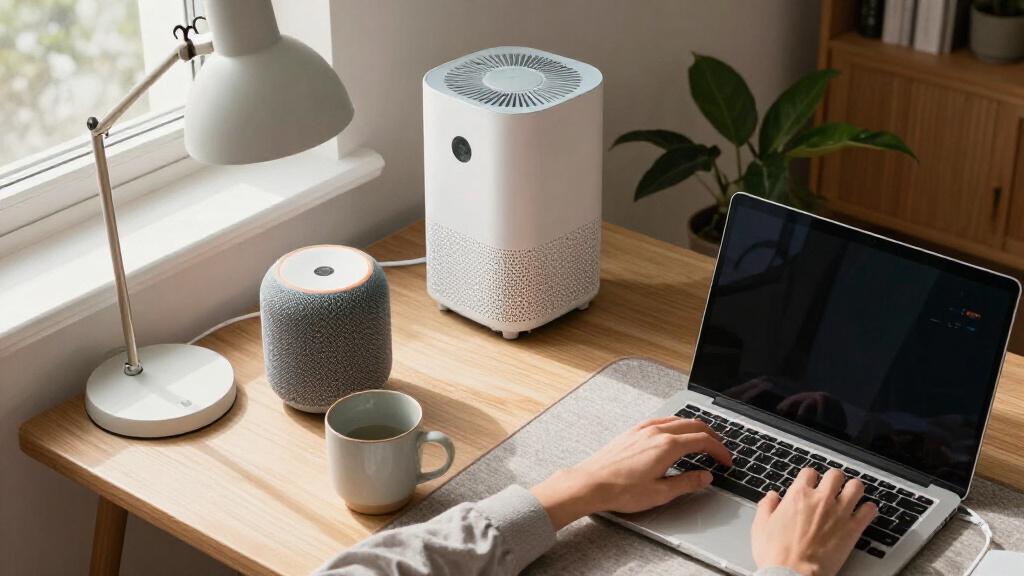

This checklist is for anyone putting together a smarter home office—whether you’re refreshing one desk or planning appliances for a full workspace. It covers air cleaning, airflow, power, charging, lighting, and document scanning, with product picks where provided and practical selection advice where no specific model is listed.

Get home appliances delivered free with Prime
- Fast, free delivery on millions of items
- Prime Video, Amazon Music and more included
- Member-only deals all year
The sections follow the job each appliance does, rather than asking you to buy everything at once. Each pick is paired with guidance on what to check before ordering, including room or desk fit, connection needs, and how the device will work with your existing setup.
Use the checklist to identify your biggest daily friction first, then confirm dimensions and compatibility before choosing a product. A fan or charger can be an advice-only category here; treat those notes as a framework for comparing options, not as a recommendation for a particular model.
Smart air purifier
An air purifier can be a useful part of a home office when you want to address the air in the space where you work. The listed pick is the Levoit Core 600S-P Smart Air Purifier for Large Rooms. Its name identifies it as a smart air purifier for large rooms, so start by comparing the room where it will sit with the area you want it to serve. Don’t assume that a large-room label automatically makes a unit the right fit for every layout or work routine.
A common mistake is choosing by feature name alone without thinking about placement and clearance. Check the product dimensions and the space around the intended location, including whether it would interfere with a desk, doorway, or other appliance. Consider where its power connection will reach and whether its controls and smart features fit the way you plan to use it. If you expect to move it between rooms, account for that in your layout rather than treating it as a fixed desk accessory.
Before buying, verify the current product details and any app or network requirements that matter to your setup. Match the purifier to the room you actually use, not a larger area you rarely occupy. A careful fit check helps keep the appliance practical in a daily work space.
What to look for:
- Compare the purifier’s stated room suitability with the space you intend to use it in.
- Check the product dimensions and leave practical room for placement.
- Confirm the location has a convenient power connection.
- Review smart-control and network requirements against your setup.
- Consider whether the unit’s placement works with your desk and room layout.
Levoit Core 600S-P Smart Air Purifier for Large Rooms

The Levoit Core 600S-P is a powerful smart air purifier designed for extra-large spaces up to 2,933 square feet. It features VortexAir Technology 3.0 and a 3-stage filtration system that achieves 99.97% efficiency against allergens and particulates.
Pros:
- AHAM Verified for reliable performance and energy efficiency
- High CADR of 391 CFM suitable for very large rooms and open floor plans
- Smart Auto Mode automatically adjusts fan speed based on air quality
- Versatile filter options available for specific needs like smoke, toxins, or pet allergies
Cons:
- Large size may be bulky for smaller rooms
- Replacement filters are sold separately and may incur ongoing costs
Best for: Home-office shoppers considering a smart purifier for a larger room
Not ideal for: Workspaces where the unit’s size or placement does not fit
Bottom line: Check room fit, dimensions, and smart requirements before choosing the Levoit Core 600S-P.
Wi-Fi desk fan
A desk fan can make airflow more convenient in a work area, while Wi-Fi control may suit someone who wants to manage an appliance through a connected setup. No specific fan is listed for this category, so use the checklist to compare models rather than treating any one feature as a must-have. Start with the airflow you need at your actual desk and whether the fan’s controls are easy to reach during the workday.
One frequent mistake is overlooking how a fan will occupy the desk. Check its footprint, height, and the space available around monitors, papers, and other equipment. Consider whether you want it on the desktop or in another position, and verify that the product’s design supports that placement. Review the power connection and cord path as well; a fan that blocks a work surface or leaves a cable crossing a busy area may be a poor fit even if its connected features look appealing.
For a Wi-Fi model, confirm the network and app requirements before purchase, and make sure the controls suit how you prefer to adjust airflow. Compare the product’s dimensions and operating details in its listing rather than relying on a general label. Prioritizing desk fit and simple control makes it easier to choose a fan that supports, rather than disrupts, your routine.
What to look for:
- Choose a fan size and shape that fit the available desk or placement area.
- Check how its controls work and whether they are convenient from your seat.
- Verify Wi-Fi, app, and network requirements for connected features.
- Review the power connection and plan a tidy cord route.
- Compare product dimensions and stated operating details before ordering.
Smart power strip
A connected outlet extender can help organize where office devices plug in, and the listed pick is the Govee Smart Plug Outlet Extender with RGB Night Light. Its name calls out smart-plug functionality and an RGB night light, but the right choice still depends on the devices and space you intend to use it with. Before ordering, review the product listing for its outlet layout, dimensions, and connection requirements rather than assuming it will match your desk arrangement.
A common buying mistake is focusing on smart features while skipping the practical outlet check. Count the devices you plan to connect and compare their plugs with the extender’s layout. Look at the shape and spacing of the outlets, especially if nearby plugs or bulky adapters could affect access. Also measure the area around the wall outlet or desk location so the extender will not conflict with furniture or other equipment. Keep the plug arrangement and clearance in mind alongside the night-light feature.
For smart control, confirm any app or network requirements and consider whether those features fit your existing routine. Think through which devices you want to control together and whether the outlet extender will be within convenient reach. Check the current product information for electrical and usage guidance, and follow it for your setup. A good match is one that fits the physical location and the devices you actually intend to connect.
What to look for:
- Compare the outlet layout with the plugs and adapters you plan to use.
- Check the extender’s dimensions and available clearance at the intended outlet.
- Confirm smart-control, app, and network requirements.
- Decide whether the RGB night light suits the placement and workspace.
- Review current product guidance for the devices you plan to connect.
Govee Smart Plug Outlet Extender with RGB Night Light

This compact outlet extender has two smart outlets, four always-on outlets, and two USB ports, with app and voice control for the smart outlets and RGB night light. It includes surge and overload protection, a flame-retardant shell, a retaining screw, and wide outlet spacing.
Pros:
- Combines two smart outlets, four always-on outlets, and two USB ports.
- Supports app and voice control, plus outlet and night-light schedules.
- Includes surge and overload protection and a flame-retardant shell.
- Retaining screw and wide outlet spacing help keep the extender secure and accommodate larger plugs.
Cons:
- USB-A output is limited to 5 W and USB-C output to 10 W.
- Only two of the six outlets are smart-controlled.
Best for: A desk setup that suits its outlet layout and connected features
Not ideal for: Setups with limited clearance or incompatible plug arrangements
Bottom line: Check outlet spacing, physical fit, and smart requirements before selecting the Govee extender.
USB-C desktop charger
A USB-C desktop charger can consolidate charging for compatible devices and keep frequently used connections close to your work area. No specific product is named for this category, so compare options against the devices you own and the way you use them at your desk. Start by listing which devices need charging and which connections they accept. A charger’s port count alone does not tell you whether it matches your setup, so focus on device compatibility first.
One common mistake is assuming every USB-C charger suits every USB-C device. Check the device makers’ charging guidance and compare it with the charger’s stated output and port details. If you expect to charge more than one device at a time, review how the charger handles simultaneous connections rather than relying only on a headline specification. Consider where the charger will sit, whether its ports will be easy to access, and how its cable will reach your devices without cluttering the workspace.
Before buying, confirm the charger’s dimensions, power connection, and any included cable details in the product listing. Make sure the placement leaves room for other desk equipment and that the cables you need are available. A well-matched desktop charger should suit your actual charging mix, not simply add ports you may not use.
What to look for:
- Match the charger’s port types to the devices you plan to charge.
- Check stated output against each device maker’s charging guidance.
- Review how simultaneous charging is described for multiple devices.
- Confirm dimensions, placement, and cable reach for your desk.
- Check whether the cables you need are included or must be supplied separately.
Smart LED desk lamp
A desk lamp can shape the light available for reading, writing, and screen-adjacent tasks. The listed pick is the LIONVISON LED Desk Lamp for Office with Clamp & Stand, Double-Side Lig. Its name identifies both a clamp and a stand, so check which mounting arrangement best suits your desk before ordering. Since the supplied name ends with “Double-Side Lig,” verify the full current listing details rather than inferring additional features from the shortened product name.
A common mistake is buying a clamp lamp without checking the desk edge or choosing a stand without considering the space it occupies. Measure the available surface and confirm that the clamp or base can be used in your intended position. Think about where the lamp will sit relative to your monitor and work materials, and whether its reach fits the area you want illuminated. The mounting option and desk clearance matter as much as the lamp’s appearance.
Before purchase, review the complete product description for controls, dimensions, and power requirements. Check how the lamp is adjusted and whether that arrangement works for your normal tasks. If your desk has a shelf, unusual edge, or limited free space, compare those details with the product’s mounting instructions. A careful fit check helps you avoid a lamp that cannot be positioned comfortably in your workspace.
What to look for:
- Confirm whether the clamp or stand is the better fit for your desk.
- Measure the desk edge or surface where the lamp will be placed.
- Check the lamp’s dimensions and reach against your work area.
- Review the full product listing for controls and power requirements.
- Confirm mounting guidance for shelves, desk edges, or limited-clearance setups.
LIONVISON LED Desk Lamp for Office with Clamp & Stand, Double-Side Lighting

This versatile LED desk lamp offers dual control methods, including remote and touch panel, with memory settings. It features dual-direction lighting to reduce eye strain, adjustable color temperatures and brightness, and a flexible mounting system with clamp or stand options.
Pros:
- Dual control options with remote and touch panel
- Reduces eye strain with dual-direction lighting
- Adjustable color temperature and brightness for various tasks
- Flexible mounting options with clamp or stand
Cons:
- Complexity may be overwhelming for simple users
- Clamp size limited to 7cm desk edge
- Higher price point due to advanced features
Best for: Workspaces where one of the listed mounting options fits
Not ideal for: Desks that cannot accommodate the clamp or stand arrangement
Bottom line: Verify the full listing and desk fit before choosing the LIONVISON lamp.
Desktop document scanner
A desktop scanner can be useful when paper documents are part of your work routine and you want a dedicated way to digitize them. The listed pick is the Epson Workforce ES-580W Wireless Color Duplex Desktop Document Scanner. Its name identifies it as a wireless color duplex desktop document scanner; check the current product details to understand how those capabilities fit the documents and workflow you have in mind.
A common mistake is buying a scanner without accounting for its physical footprint or the space needed to operate it. Measure the intended surface and leave room to handle documents, connect power, and access the scanner comfortably. Consider the types and sizes of documents you expect to process, then review the product specifications for supported formats and handling guidance. Don’t assume that the word “wireless” removes the need to check setup requirements or connection compatibility. Confirm how it connects with your computer or other devices and whether that workflow suits your office.
Before choosing, review the current listing for software, operating-system, and network details relevant to your setup. Think about where scanned files need to go and how often you expect to use the device. A scanner is most practical when its document workflow and footprint fit both the work you do and the space available.
What to look for:
- Compare scanner dimensions with the available desktop or storage space.
- Check supported document sizes and handling guidance in the product details.
- Confirm wireless setup and connection compatibility for your devices.
- Review software and operating-system requirements before purchase.
- Consider document volume and where scanned files need to go.
Epson Workforce ES-580W Wireless Color Duplex Desktop Document Scanner

The Epson Workforce ES-580W is a high-speed, wireless color scanner with a 4.3-inch touchscreen, capable of handling up to 100 sheets with its auto document feeder. It offers versatile connectivity options, including direct saving to USB, email, and cloud services, and supports OCR for creating searchable PDFs and editable files.
Pros:
- Fast scanning speed of 35 pages per minute
- Wireless connectivity with cloud and USB options
- Supports OCR for searchable and editable files
- Handles large volumes with 100-sheet ADF
Cons:
- Requires setup for wireless connection
- May be complex for first-time users
- Higher price point for advanced features
Best for: Home offices that regularly handle paper documents
Not ideal for: Workspaces without room for a desktop scanner or its workflow
Bottom line: Check document support, software requirements, and placement before choosing the Epson ES-580W.
For a budget-first buying order, start with the appliance that solves the most immediate workday problem, then add other categories as needed. Before committing, compare fit and compatibility: room and placement for the purifier, desk space for a fan or lamp, outlet layout for an extender, charging needs for a USB-C unit, and document workflow for a scanner.
You do not need to build the whole setup at once. Use this checklist to narrow your choices, confirm product details for your own workspace, and add appliances when they serve a clear purpose. A few carefully matched tools can make a more functional home office without filling every available surface.