
TL;DR

Get home appliances delivered free with Prime
- Fast, free delivery on millions of items
- Prime Video, Amazon Music and more included
- Member-only deals all year
TikTok user Birdie Wood demonstrated turning chindi rag rugs into a loose, colorful window covering by cutting the fabric strips apart and tying them onto a curtain rod. Hunker reported that she bought the rugs at Five Below for $5 each; the project’s final cost and practical performance as a window covering have not been independently established.
TikTok user Birdie Wood demonstrated a do-it-yourself window covering made by unraveling chindi rag rugs and tying their fabric strips onto a curtain rod. Hunker reported that she bought the rugs for $5 each at Five Below, presenting the project as a low-cost, colorful alternative to conventional curtains or blinds.
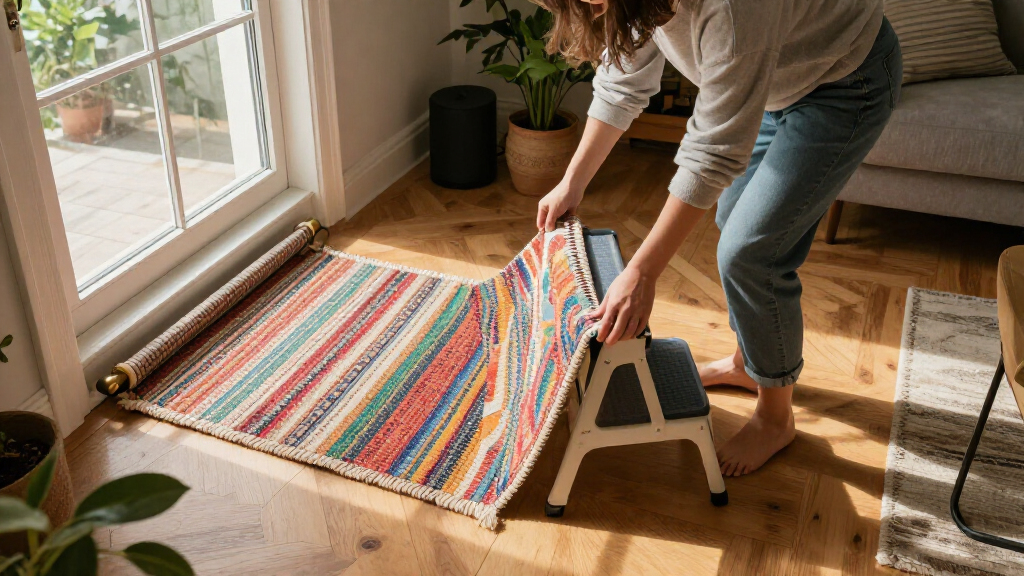
The method begins with a rug made of fabric strips, often scraps, sewn or bound together. Wood cut the strings holding the strips in tight bundles, separated the fabric, then looped the strands around a curtain rod. The result is a loose, billowy covering with a mix of colors and patterns that may be less visible when the fabric is woven into a rug.
Hunker says the materials can be limited to a rug, a rod and sharp scissors, though the work requires time and patience. Strips can be cut to the desired length or tied together to span more height. The same approach can create a short valance, or use strands of different lengths for a layered, swag-like effect.
The report describes several ways to attach and style the fabric. Users can tie each strip directly onto a rod, leave the top of the rug intact as a header and attach it with curtain clips, or fasten the separated strands to a horizontal ribbon so they move together. Hunker also suggests braiding strands, tying them back with ribbon or adding beads. Those are design options, not tested performance claims.
A Low-Cost Alternative With Limits
The project offers a way to reuse a household textile for a visible home update, and its reported $5-per-rug price could appeal to renters or homeowners looking for a decorative treatment on a small budget. The approach also allows customization: the maker can vary strip length, fullness and arrangement without buying fabric by the yard.
But a colorful textile treatment is not automatically a functional replacement for curtains or blinds. The source does not say whether the hanging strips block sunlight, provide privacy, reduce heat or meet any safety standards. The loose design is presented as a decorative option, especially for boho, eclectic or maximalist rooms, rather than a tested solution for light control or insulation. Buyers should consider the window’s needs and the material’s care before copying the project.
Products Worth Considering

Ring Battery Doorbell 2K Plus (2nd Gen) and Spotlight Cam Plus Battery Bundle

Ring Wired Doorbell Plus (2nd Gen) and Chime (3rd Gen), Nickel Silver and White

Ring Battery Doorbell Plus (2nd Gen) with Chime Plus, Nickel Silver and White
As an affiliate, we earn on qualifying purchases.
How Chindi Rugs Become Fabric Strips
Chindi rugs are rag rugs made from strips of fabric, with Hunker describing them as originating in India and commonly incorporating assorted scrap materials. Their construction gives the DIY project its basic premise: undo the bindings that hold the fabric strips in the rug, then repurpose those strips as hanging material.
Hunker cited the creator’s Five Below purchase at $5 per rug and also mentioned an online chindi rug listed at $10 on Amazon. Those are examples in the report, not a guarantee of current prices or availability. The amount of window area a rug will cover depends on its size, how densely the strips are hung and the finished length; the report does not provide measurements or a standard coverage estimate.
““a boho-chic curtain alternative””
— Hunker, describing the project
Cost, Coverage and Performance
The source does not provide the dimensions of Wood’s rugs or window, the number of rugs used, the finished treatment’s coverage, or the total project cost beyond the reported $5 price per rug. It also does not establish whether the strips were washed, treated or secured in a way that affects durability. Light blocking, privacy, cleaning requirements and long-term wear are not evaluated in the report.
Hunker’s account presents a creator’s demonstration and styling suggestions; it does not include independent testing or a comparison with standard curtains and blinds. Rug prices and stock can change, so the cited retail examples should not be treated as current quotes.
Planning the Window Treatment
Anyone adapting the idea would first need to measure the window and decide whether the goal is decoration, privacy or light control. The creator’s approach then involves choosing a rug, cutting the binding strings, sorting and trimming the strips, and securing them to a rod or header. Before hanging the finished piece, makers can check that the rod and its brackets are appropriate for the material’s weight and that the fabric does not obstruct the window’s operation.
The Hunker report does not announce a follow-up test, product launch or wider rollout. The next developments are therefore practical rather than scheduled: current rug prices, the result in a particular room and how the fabric holds up after use would need to be checked by anyone considering the project.
Key Questions
What is a chindi rug?
A chindi rug is a rag rug made from strips of fabric, often assorted scraps. In this project, the strips are separated and repurposed as hanging material.
How did the creator attach the fabric?
Hunker says Birdie Wood looped the separated strips around a curtain rod. The report also describes alternatives, including tying the strips to the rod or attaching them to a horizontal ribbon or fabric header.
How much does the project cost?
The creator reportedly bought rugs at Five Below for $5 each. The final cost depends on how many rugs and other materials are needed, and the source does not give a total. Prices may change.
Will the rug covering block light or provide privacy?
The report does not test or specify how much light the strips block or how much privacy they provide. The design is described as a decorative alternative, so its practical performance should not be assumed.
Can the project be styled in different ways?
Yes. The strips can be cut to different lengths, arranged as a short valance, braided, tied back with ribbon or hung from a header. Hunker says the mixed colors and patterns suit boho, eclectic or maximalist interiors.
Source: hunker.com