For most households, I’d start with the Tapo P110M Matter Smart Plugs: the 15A rating, four-pack format, energy tracking, and Matter support make them a balanced choice for monitoring several devices. The Emporia Smart Plugs suit buyers who want plug-level readings alongside a broader energy-monitoring setup, while the Minoston Z-Wave Plug is a better match for homes already built around a Z-Wave hub. The tradeoff is that features such as Matter, hub-based control, Wi-Fi bands, and pack size affect compatibility and convenience as much as energy reporting does. I’ve compared all 13 options by connectivity, monitoring focus, electrical rating, and setup fit. Read on for the full breakdown and guidance on choosing a plug that works with your devices and smart-home system.

Get home appliances delivered free with Prime
- Fast, free delivery on millions of items
- Prime Video, Amazon Music and more included
- Member-only deals all year
Complete the kit


Key Takeaways
- Tapo P110M Matter stands out as the most balanced multi-plug option in this group: its 15A rating and Matter support suit buyers who want flexibility across compatible smart-home platforms.
- Emporia’s four-plug set is the clearest fit for buyers who want plug readings to sit alongside a broader energy-monitoring system, rather than treating each plug as a separate tool.
- The Tapo P115 appears in both two- and four-pack formats, so buyers can choose coverage without switching models; the P110M adds Matter, making platform compatibility a meaningful distinction.
- The Minoston Z-Wave plug and NOUS A9 5 GHz plug target different network setups. Neither is a universal upgrade over ordinary Wi-Fi; the right choice depends on the home’s hub and router.
- Pack size and electrical rating change the value of a set: options range from a single plug to four-packs, while the SimpleHut is rated at 10A and several Tapo models are rated at 15A.




| smart plugs with energy monitoring | Pack size | Connectivity | Model | Operating voltage |
|---|---|---|---|---|
| Govee Smart Plug with Energy M | 4 plugs | Wi-Fi and Bluetooth | H5086 | 120 V AC |
| Tapo P110M Matter Smart Plugs | 4 plugs | Matter and Wi-Fi | — | — |
| Tapo P115 Smart Wi-Fi Plug wit | 2 plugs | 2.4 GHz Wi-Fi | P115 | 125 V |
| Emporia Energy Monitoring Smar | 4 plugs | 2.4 GHz Wi-Fi | — | 120 V |
| Tapo P115 Smart Wi-Fi Plug wit | 4 plugs | 2.4 GHz Wi-Fi | P115 | 110 V AC |
| SimpleHut Smart Plug with Ener | 2 plugs | 2.4 GHz Wi-Fi | WHDM01 | 240 V |
| NOUS A9 5 GHz Wi-Fi Smart Plug | 1 plug | 2.4 GHz and 5 GHz Wi-Fi | A9 | — |
| Tapo P110M Smart Plug | 2 plugs | 2.4 GHz Wi-Fi | P110M | — |
| Minoston Z-Wave Smart Plug wit | — | — | MP21ZP (VER 8.0) | — |
| THIRDREALITY Smart Plug Gen3 | 4 plugs | Zigbee 3.0 | — | 110 V |
| Emporia Whole-Home Energy Moni | — | — | — | — |
| AiSeek Smart Plug with Energy | 4 | 2.4 GHz Wi-Fi and Bluetooth | KT-US-EM-15AP | 120 V |
| Kasa Matter Smart Plug with En | 4 | Matter, Wi-Fi, and SmartThings | KP125MP4 | 120 V |
More Details on Our Top Picks
Govee Smart Plug with Energy Monitoring, Wi-Fi and Bluetooth, 4-Pack
The Govee Smart Plug earns its place for buyers who want more than a live wattage glance: it tracks power, current, and voltage, with history available for up to a year. That extended record can help you spot changing appliance use over time, while schedules, group control, and Alexa or Google Assistant support cover everyday automation. Compared with the Tapo P115 4-Pack, Govee offers the clearest stated advantage for long-term data retention; the Tapo instead highlights energy-cost estimates and compact outlet fit. The tradeoff is that Govee relies on the Govee Home app for app control and requires 2.4 GHz Wi-Fi, so it is a less flexible choice for households with 5 GHz-only networks or those seeking broad smart-home platform compatibility. Its four-plug bundle suits monitoring several appliances at once.
Pros:- Tracks power, current, and voltage, with up to one year of data history
- Four plugs support monitoring several devices from one bundle
- Offers scheduling, group control, remote access, and touch control
- Works with Amazon Alexa and Google Assistant
Cons:- Does not support 5 GHz Wi-Fi
- App-based control requires the Govee Home app
- The listed 1800 W maximum calls for care with high-load appliances
Best for: Households that want long-term power, current, and voltage history across several appliances, and already use 2.4 GHz Wi-Fi with Alexa or Google Assistant.
Not ideal for: Smart-home users who need 5 GHz Wi-Fi support or want energy monitoring and control through platforms beyond the Govee Home app, Alexa, and Google Assistant.
- Model:H5086
- Pack size:4 plugs
- Connectivity:Wi-Fi and Bluetooth
- Wi-Fi compatibility:2.4 GHz; does not support 5 GHz
- Operating voltage:120 V AC
- Maximum wattage:1800 W
- Voice assistants:Amazon Alexa and Google Assistant
- Certifications:ETL and FCC
Our verdict“Choose Govee if extended, multi-measurement energy history matters more to you than broad platform support or 5 GHz connectivity.”
Tapo P110M Matter Smart Plugs with Energy Monitoring, 4-Pack, 15A
The Tapo P110M 4-Pack is the strongest fit here for buyers who want energy monitoring without tying their automations to one assistant. Matter compatibility brings support for Alexa, Apple HomeKit, Google Home, and Samsung SmartThings, while energy statistics and bill estimates make consumption easier to interpret. Compared with the Govee four-pack, its main distinction is that broader smart-home platform reach rather than Govee’s stated year of detailed power, current, and voltage history. Its compact design can also leave a neighboring outlet usable, a practical benefit when plugs share a wall plate. The tradeoff is familiar across several picks in this roundup: it needs 2.4 GHz Wi-Fi and does not serve homes that rely on 5 GHz-only connectivity. Buyers who do not need Matter or cross-platform control may find the simpler Tapo P115 2-pack sufficient.
Pros:- Matter compatibility supports Alexa, Apple HomeKit, Google Home, and Samsung SmartThings
- Energy statistics and bill estimates help translate use into household costs
- Four plugs provide coverage for multiple appliances
- Compact design helps keep neighboring outlets accessible
Cons:- Requires 2.4 GHz Wi-Fi and does not support 5 GHz
- Energy bill estimates may be less useful to buyers who only need basic consumption readings
- No long-term history duration is specified in the supplied product details
Best for: Households using a mix of Apple HomeKit, Alexa, Google Home, or SmartThings that want energy tracking across multiple outlets.
Not ideal for: Buyers with 5 GHz-only Wi-Fi or those who need the longest explicitly stated energy-history period rather than broad Matter compatibility.
- Pack size:4 plugs
- Connectivity:Matter and Wi-Fi
- Wi-Fi band:2.4 GHz
- Maximum wattage:1800 W
- Compatible platforms:Amazon Alexa, Apple HomeKit, Google Home, and Samsung SmartThings
- Control methods:App, voice, scheduling, and remote control
- Energy features:Energy monitoring, statistics, bill estimates, configurable power thresholds, and overcharge protection
- Color:White
Our verdict“Pick the Tapo P110M if you want four energy-monitoring plugs that can join a Matter-based, multi-platform smart home.”
Tapo P115 Smart Wi-Fi Plug with Energy Monitoring, 2-Pack, 15A
For a first energy-monitoring setup or a couple of specific appliances, the Tapo P115 2-Pack keeps the commitment small while still offering consumption charts and estimated electricity costs in the Tapo app. Scheduling and automatic shutoff features add a practical layer of control, and its compact build is less likely to crowd a neighboring outlet. Compared with the Tapo P115 4-Pack, this version makes more sense when you only need to track one or two devices; the larger bundle is better suited to spreading monitoring around a home. It also differs from the Tapo P110M by omitting stated Matter support, so buyers seeking broad platform flexibility should look there instead. The main limitation is 2.4 GHz-only Wi-Fi, and the supplied details name Alexa and Google Assistant voice support rather than the wider platform list of the P110M.
Pros:- Energy statistics and charts help identify consumption patterns
- Cost estimates give usage data a household-bill context
- Scheduling and automatic shutoff support everyday control
- Compact plugs help preserve access to neighboring outlets
Cons:- Two-plug pack offers less coverage than the Tapo P115 4-Pack
- Works with 2.4 GHz Wi-Fi only
- The supplied details do not list Matter compatibility
Best for: Renters or first-time energy-monitoring buyers who want to track one or two appliances and view usage or cost estimates in the Tapo app.
Not ideal for: Households that need four monitored outlets, Matter-based platform flexibility, or 5 GHz Wi-Fi support.
- Model:P115
- Pack size:2 plugs
- Maximum wattage:1800 W
- Operating voltage:125 V
- Connectivity:2.4 GHz Wi-Fi
- Voice assistants:Amazon Alexa and Google Assistant
- Compatible platform:Samsung SmartThings
- Certifications:ETL, FCC, and RoHS
Our verdict“Choose this two-pack when you want a compact, app-based way to track a small number of appliances without buying four plugs.”
Emporia Energy Monitoring Smart Plugs, Wi-Fi, 4-Pack
The Emporia four-pack suits buyers who want straightforward monitoring and control for lights and other modest-load devices. It tracks connected-device energy use and combines scheduling, remote app control, and Alexa or Google Assistant support, while the four-plug bundle covers several rooms or appliances. Its key difference from the Tapo P110M is a lower stated power ceiling: Emporia is rated at 1200 W and 10 A continuous, compared with the Tapo’s listed 1800 W. That makes the Emporia a more limited choice for higher-load equipment, so buyers should match the rating to each device before plugging it in. The simpler platform list is another tradeoff: unlike the Matter-based Tapo, this model does not list Apple HomeKit or SmartThings compatibility. It also requires 2.4 GHz Wi-Fi.
Pros:- Four plugs allow monitoring across multiple lower-power devices
- Tracks energy use for connected equipment
- Supports remote app control and scheduling
- Works with Amazon Alexa and Google Assistant
Cons:- 1200 W maximum and 10 A continuous-load limit are below the 1800 W rating listed for the Tapo options
- Requires 2.4 GHz Wi-Fi and does not support 5 GHz
- Voice-assistant support is limited in the supplied details to Alexa and Google Assistant
Best for: Buyers who want four plugs for lamps and other lower-power devices, with app scheduling and Alexa or Google Assistant control.
Not ideal for: People monitoring higher-load appliances or building a Matter-based setup with Apple HomeKit or SmartThings, given the 1200 W rating and listed platform support.
- Pack size:4 plugs
- Operating voltage:120 V
- Maximum wattage:1200 W
- Continuous load:10 A
- Connectivity:2.4 GHz Wi-Fi
- Control methods:App, remote, touch, voice, and push button
- Voice assistants:Amazon Alexa and Google Assistant
- Warranty:1 year
Our verdict“Choose Emporia for a four-plug setup focused on lights and modest loads, but select a higher-rated option for appliances approaching its limit.”
Tapo P115 Smart Wi-Fi Plug with Energy Monitoring, 4-Pack, 15A
The Tapo P115 4-Pack is a practical choice for monitoring several appliances without stepping up to the Matter-focused P110M. It combines energy statistics, cost estimates, schedules, and automatic shutoff with voice control through Alexa, Google Assistant, and SmartThings. Its compact shape is useful when multiple plugs share a wall plate, while the 1800 W rating gives it more headroom on paper than the Emporia four-pack, which is listed at 1200 W. Compared with the Tapo P115 2-Pack, the main advantage is broader coverage in one purchase; the smaller pack is a better fit for a limited monitoring project. The tradeoff is 2.4 GHz-only Wi-Fi, and the supplied details say smart charging and cost estimates depend on app settings and integrations. Buyers seeking Matter support should choose the P110M instead.
Pros:- Four compact plugs make it easier to monitor multiple devices around the home
- Energy statistics and charts support tracking consumption over time
- Cost estimates, scheduling, and automatic shutoff add useful app controls
- Lists Alexa, Google Assistant, and SmartThings control
Cons:- Supports 2.4 GHz Wi-Fi only
- Smart charging and energy cost estimates depend on app settings and integrations
- Does not list Matter compatibility, unlike the Tapo P110M
Best for: Households that want to monitor several everyday appliances and use Tapo energy charts, cost estimates, and voice control without requiring Matter.
Not ideal for: People with 5 GHz-only Wi-Fi or smart-home owners who need Matter compatibility and its broader platform integration.
- Model:P115
- Pack size:4 plugs
- Operating voltage:110 V AC
- Maximum wattage:1800 W
- Connectivity:2.4 GHz Wi-Fi
- Control platforms:Tapo app, Amazon Alexa, Google Assistant, and SmartThings
- Material:Polycarbonate
- Certifications:ETL, FCC, and RoHS
Our verdict“Choose the Tapo P115 four-pack for broad appliance coverage and app-based energy tracking, or the P110M if Matter support is a priority.”
SimpleHut Smart Plug with Energy Monitoring, 10A, 2-Pack
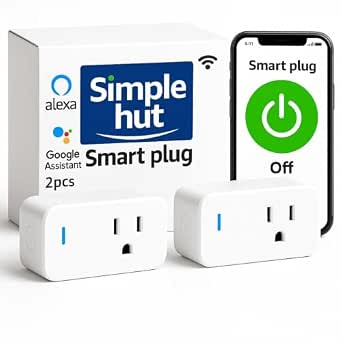
The SimpleHut makes the most sense for buyers who want two monitored outlets without adding a hub. Its Smart Life app supports remote control and schedules, while Alexa and Google Assistant offer voice control. Compared with the Tapo P110M 2-pack, it is less flexible across smart-home platforms: the Tapo supports Matter and Apple HomeKit, while SimpleHut sticks to Alexa and Google Assistant. The tradeoff is a straightforward setup for households already using Smart Life, with no separate hub to manage. Its 2.4 GHz-only Wi-Fi requirement may also rule it out for buyers whose network setup does not support that band. The listed 10A rating makes this better suited to everyday lower-power appliances than devices that need a higher-capacity plug.
Pros:- Energy monitoring is included in a two-plug pack
- Works with Alexa and Google Assistant
- Smart Life supports remote control and timer scheduling
- No hub is required
Cons:- Requires a 2.4 GHz Wi-Fi network
- Does not list Matter or Apple HomeKit compatibility
- The 10A rating is lower than the 15A rating listed for Tapo P110M
Best for: Smart Life users who want two outlets for scheduling and tracking everyday, lower-power devices through Alexa or Google Assistant.
Not ideal for: Apple HomeKit or Matter households, and buyers who need a plug rated above 10A or cannot connect devices to 2.4 GHz Wi-Fi.
- Brand:SimpleHut
- Model:WHDM01
- Pack size:2 plugs
- Connectivity:2.4 GHz Wi-Fi
- App:Smart Life
- Voice assistants:Alexa, Google Assistant
- Operating voltage:240 V
- Wattage:240 W
Our verdict“Choose SimpleHut for basic app-based energy tracking across two outlets if you use Smart Life and do not need Matter or a higher amperage rating.”
NOUS A9 5 GHz Wi-Fi Smart Plug (1 Pack) with Energy Monitoring
The NOUS A9 stands out in this lineup for supporting both 2.4 GHz and 5 GHz Wi-Fi, so it can suit buyers whose router setup or device network favors the less commonly supported 5 GHz band. Its compact dimensions are another practical advantage: the plug is designed not to block the neighboring outlet, a useful fit for crowded strips. Like the SimpleHut Smart Plug, it needs no hub and offers energy monitoring plus app and voice control; unlike SimpleHut, it is sold as a single plug, not a two-pack. The listed 120 V limit also narrows where it can be used, and its IP20 rating offers no water or dust protection. Choose it for indoor, space-constrained setups—not damp locations or 220–240 V regions.
Pros:- Supports both 2.4 GHz and 5 GHz Wi-Fi
- Compact design leaves the adjacent outlet available
- Real-time energy monitoring
- Works with Alexa and Google Assistant without a hub
Cons:- Single-plug pack offers less coverage than SimpleHut’s two-pack
- Limited to 120 V use
- IP20 rating provides no water or dust protection
Best for: Buyers with a dual-band router who want one compact, hub-free plug for monitoring an indoor appliance without blocking a nearby outlet.
Not ideal for: Households in 220–240 V regions, users seeking water- or dust-protected outdoor control, or buyers who want multiple plugs in one pack.
- Brand:NOUS
- Model:A9
- Pack size:1 plug
- Connectivity:2.4 GHz and 5 GHz Wi-Fi
- Voltage:120 V
- Dimensions:2.36 × 1.5 × 2.05 inches
- Control:App, voice, remote, scheduling
- Compatible assistants:Alexa, Google Assistant
Our verdict“Pick the NOUS A9 if dual-band Wi-Fi support and a space-saving body matter more than pack size or protection from dust and water.”
Tapo P110M Smart Plug (2-Pack), Matter Compatible, Energy Monitoring, 15A
For buyers choosing by ecosystem flexibility, the Tapo P110M is the clearest pick here: Matter compatibility links it with Alexa, Apple HomeKit, Google Home, and SmartThings. Its detailed energy monitoring is paired with overcharge prevention and power-management safeguards, making the readouts useful alongside controls intended to help manage connected devices. Compared with the SimpleHut two-pack, the Tapo supports more named platforms and carries a listed 15A rating rather than 10A. It also costs more setup effort in app terms: the product data says the Tapo app is needed for full configuration and control. Wi-Fi is 2.4 GHz only, so it does not share the NOUS A9’s 5 GHz option. The compact two-plug format suits homes that want broad compatibility without a hub.
Pros:- Matter support spans several major smart-home platforms
- Detailed energy monitoring can help track consumption and estimate bills
- 15A rating and listed 1800-watt capacity
- Compact design and overcharge-prevention features
Cons:- Uses 2.4 GHz Wi-Fi only
- Full configuration and control require the Tapo app
- Offers two plugs, fewer than the four-pack options in the roundup
Best for: Households mixing Apple HomeKit, Alexa, Google Home, or SmartThings that want energy monitoring and 15A plugs in a two-pack.
Not ideal for: Buyers who need 5 GHz Wi-Fi support or prefer to configure and control every feature without the Tapo app.
- Model:P110M
- Pack size:2 plugs
- Connectivity:2.4 GHz Wi-Fi
- Smart-home compatibility:Matter, Alexa, Apple HomeKit, Google Home, Samsung SmartThings
- Wattage:1800 W
- Control:App, voice
- Safety features:Overcharge prevention, power management
Our verdict“Choose the Tapo P110M when Matter compatibility and 15A capacity outweigh the app requirement and 2.4 GHz-only connection.”
Minoston Z-Wave Smart Plug with Energy Monitoring
The Minoston is the specialist choice for homes already built around a Z-Wave hub. It monitors energy, supports schedules and timers, and its 800-series radio can help extend Z-Wave coverage—useful when a smart-home network needs another powered connection point. Its S2 security and SmartStart pairing make it more appealing to an established hub user than a simple Wi-Fi plug such as the SimpleHut, which connects directly to a router and needs no hub. That network commitment is also the main drawback: a compatible hub is sold separately, and voice control depends on the hub. The 125 V, 15 A specifications suit supported North American setups, but this single plug is a poor entry point for someone starting from scratch or seeking a standalone Wi-Fi monitor.
Pros:- Energy monitoring with timers and schedules
- Z-Wave 800-series chip includes S2 security and SmartStart
- Can extend Z-Wave network coverage
- 15A rating and two-year warranty
Cons:- Requires a compatible hub sold separately
- Alexa and Google Assistant control depend on a compatible hub
- Cannot connect directly to Echo Plus
Best for: SmartThings, Hubitat, Vera, or other compatible Z-Wave hub owners who want monitored outlet control and another node for network coverage.
Not ideal for: People without a Z-Wave hub, buyers seeking direct Wi-Fi setup, or users in regions that require 220–240 V equipment.
- Brand:Minoston
- Model:MP21ZP (VER 8.0)
- Wireless standard:Z-Wave 800 series
- Voltage:125 V
- Amperage:15 A
- Dimensions:1.14 × 1.89 × 1.89 inches
- Hub required:Yes; sold separately
- Compatible platforms:SmartThings, Hubitat, Vera, Wink, Z-Box Hub, Fibaro, Ring, 2GIG, HomeSeer
- Warranty:2 years
Our verdict“Buy the Minoston if you already run a compatible Z-Wave hub and want monitoring that can also strengthen that network.”
THIRDREALITY Smart Plug Gen3, 4-Pack
THIRDREALITY’s strongest case is the combination of four energy-monitoring plugs and Zigbee repeating, which can add both monitored outlets and coverage to a compatible mesh. The stated ±1% monitoring accuracy gives buyers a specific accuracy claim to compare against options whose data does not list one. Unlike the Wi-Fi-based Tapo P110M two-pack, this set needs a Zigbee hub, so the larger pack is most useful when that hub is already part of the home. It is rated at 15 A, and the space-saving design is intended to leave nearby sockets free. One limitation is that customizable power-restoration settings work only on select platforms; the product data also does not name a voltage range beyond 110 V. Check platform and electrical compatibility before choosing it.
Pros:- Four plugs provide broad coverage for multiple monitored devices
- Specified power-monitoring accuracy of ±1%
- Each plug can repeat Zigbee signals to extend mesh coverage
- 15A rating and space-saving design
Cons:- Requires a compatible Zigbee hub
- Power-restoration settings are available only on select platforms
- Listed operating voltage is 110 V, so check suitability for the intended setup
Best for: Zigbee hub owners who want to monitor several devices at once while adding repeaters to improve mesh coverage.
Not ideal for: Wi-Fi-only smart-home users, buyers without a compatible Zigbee hub, or anyone who needs power-restoration settings on an unsupported platform.
- Pack size:4 plugs
- Connectivity:Zigbee 3.0
- Operating voltage:110 V
- Power-monitoring accuracy:±1%
- Control methods:Remote, voice
- Hub required:Yes
- Warranty:1 year
Our verdict“Choose this four-pack if you already have a compatible Zigbee hub and want accurate monitoring across several outlets plus mesh repeaters.”
Emporia Whole-Home Energy Monitor Bundle with 16 Sensors and 4 Smart Plugs
The Emporia Whole-Home Energy Monitor Bundle is the broadest choice here for buyers who want plug-level readings as part of a larger view of household electricity use. Along with four energy-monitoring smart plugs, it tracks whole-home consumption and up to 16 individual circuits, which can help identify whether savings should come from a plug-in appliance or a larger circuit. Its app supports schedules and energy management tied to peak demand, time-of-use, or excess solar. Compared with the AiSeek 4-pack, this bundle reaches beyond individual outlets, but it also asks for a more involved setup: the monitor requires installation in the electrical panel. Usage data is stored in the cloud, a tradeoff for buyers who prefer local-only monitoring. I’d choose it for system-wide visibility, not for a simple plug-only setup.
Pros:- Combines whole-home monitoring with readings for up to 16 individual circuits
- Includes four smart plugs for tracking and controlling plug-in devices
- App supports schedules and energy management based on time-of-use, peak demand, or excess solar
- Supports solar systems and Alexa-enabled devices
Cons:- The energy monitor requires installation in the home’s electrical panel
- Usage data is stored in the cloud
- The broader monitoring setup may be more involved than a plug-only kit
Best for: Homeowners who want to compare plug-in appliance use with whole-home, circuit-level, and solar-related energy data
Not ideal for: Renters or buyers who only want outlet-level tracking and do not want electrical-panel installation or cloud-stored usage data
- Energy monitor sensors:16
- Smart plugs included:4
- App compatibility:iOS and Android
- Compatible devices:Smart plugs, energy monitors, solar systems, iOS devices, Android devices, and Alexa-enabled devices
- Solar support:Net metering
- Energy data:Second-by-second data
Our verdict“Choose Emporia if you want four monitored plugs alongside circuit-level and whole-home energy visibility, and can accommodate panel installation and cloud data storage.”
AiSeek Smart Plug with Energy Monitoring, 15A, 2.4 GHz Wi-Fi, 4-Pack
The AiSeek 4-pack suits buyers who want energy readings across several appliances without adding a hub or a whole-home monitor. It tracks real-time power and energy use, while schedules, timers, and group control make routine device management straightforward. Setup and voice-assistant linking run through the SmartLife app; Alexa and Google Assistant support adds flexibility, but it does mean another app is part of the setup. Compared with the Kasa Matter KP125MP4, AiSeek lists broad assistant support but does not offer Matter compatibility or the stated local-network control when internet service is unavailable. Its 2.4 GHz Wi-Fi requirement also rules out setups that rely only on other bands. I’d pick it for app-based monitoring and control across four outlets, rather than for cross-platform smart-home integration.
Pros:- Four plugs provide real-time power and energy monitoring
- Schedules, timers, and group control support routine automation
- Works with Amazon Alexa and Google Assistant
- Compact design includes short-circuit and overload protection
Cons:- Requires a 2.4 GHz Wi-Fi connection
- SmartLife is required for setup and voice-assistant linking
- Does not list Matter support or local control during internet outages
Best for: Buyers who want four individually monitored outlets with timers and group control in a SmartLife-based setup
Not ideal for: Households seeking Matter integration, internet-independent local control, or Wi-Fi that does not include a 2.4 GHz network
- Model:KT-US-EM-15AP
- Pack size:4
- Maximum load:1800 W
- Operating voltage:120 V
- Connectivity:2.4 GHz Wi-Fi and Bluetooth
- Compatible assistants:Amazon Alexa and Google Assistant
- Apps:SmartLife and Tuya
- Dimensions:1.4 x 2.8 x 2 inches
- Warranty:2 years
Our verdict“Choose AiSeek for four app-managed, energy-monitoring outlets with Alexa and Google Assistant support, but skip it if Matter or offline local control matters more.”
Kasa Matter Smart Plug with Energy Monitoring, KP125MP4, 4-Pack
The Kasa KP125MP4 is the strongest fit in this group for buyers who want energy monitoring without tying their smart-home setup to one assistant. Its Matter compatibility spans Apple Home, Alexa, Google Home, and SmartThings, while local-network communication can keep compatible controls working when internet access is unavailable. That makes it a more flexible platform choice than the AiSeek 4-pack, which relies on SmartLife for setup and voice-assistant linking. The Kasa pack also monitors energy use and supports loads up to 1800 W, but its Wi-Fi is limited to 2.4 GHz. Buyers should check that their network and Matter controller fit their setup; the listed compatibility does not remove the need for compatible devices. I’d favor Kasa when platform flexibility and local control matter more than a whole-home view like Emporia provides.
Pros:- Matter compatibility supports several major smart-home platforms
- Tracks energy use at the outlet
- Compatible local-network control can work when internet access is unavailable
- Compact, UL-certified flame-retardant design
Cons:- Wi-Fi connectivity is limited to 2.4 GHz
- Local control depends on compatible devices and network setup
- Does not provide the whole-home and circuit-level monitoring included with the Emporia bundle
Best for: Households using Apple Home, Alexa, Google Home, or SmartThings that want energy monitoring and compatible local-network control
Not ideal for: Buyers who need 5 GHz-only Wi-Fi or want circuit-level and whole-home monitoring in addition to outlet readings
- Model:KP125MP4
- Pack size:4
- Maximum wattage:1800 W
- Operating voltage:120 V
- Connectivity:Matter, Wi-Fi, and SmartThings
- Wi-Fi band:2.4 GHz
- Compatible platforms:Apple Home, Amazon Alexa, Google Home, and Samsung SmartThings
- Design:Compact, UL-certified flame-retardant
- Warranty:2-year limited warranty
Our verdict“Choose the Kasa pack if you want four energy-monitoring plugs that fit a Matter-based smart home, and prioritize Emporia if you also need circuit-level readings.”
How We Picked
I compared these plugs on the features that shape the day-to-day usefulness of energy monitoring: whether they report device-level consumption, how clearly their connectivity and electrical limits are specified, and whether their app or smart-home approach suits a single plug or a wider setup. I also weighed pack size, platform compatibility, and the likely effort required to fit each option into an existing home network. A 15A rating can matter when matching a plug to an appliance, while a hub-based model may make more sense for someone already using that hub than for a Wi-Fi-only household.
The ranking favors flexibility and a clear use case over a long feature list. Tapo’s Matter-equipped P110M leads for its combination of 15A capacity, multi-plug coverage, and cross-platform potential; Emporia follows for buyers who want plug readings connected to a broader energy picture. Other picks rank higher for narrower needs, such as a particular Wi-Fi band, Z-Wave control, or a whole-home monitoring bundle. I treat pack counts, model variants, and electrical limits as part of the buying decision, not as proof that one plug will suit every device.
Factors to Consider When Choosing Smart Plugs With Energy Monitoring
Energy monitoring is useful only when the plug fits the device, the network, and the kind of information you want to act on. I’d settle those basics before choosing a pack size or smart-home platform.
Match the Plug’s Rating to the Device
Check the appliance’s electrical requirements and the plug’s stated rating before buying; a 15A model and a 10A model are not interchangeable for every load. The SimpleHut in this lineup is rated at 10A, while several Tapo options specify 15A, so the rating can narrow your shortlist quickly. Do not assume a plug is suitable for a high-draw appliance just because its app can switch that appliance on and off. Compare the device label and the plug’s documentation, including any restrictions on motorized or heating loads. If the match is unclear, choose a different control method rather than relying on a smart plug outside its stated limits.
Decide What Energy Data You’ll Actually Use
A plug reading tells you about the device connected to that plug, not automatically about every circuit or appliance in your home. If your goal is to identify the consumption of a lamp, fan, or entertainment setup, plug-level monitoring may answer the question. If you want a wider view of household use, a whole-home monitor bundle such as Emporia’s addresses a different job, and its extra sensors may be more relevant than adding individual plugs. Before paying for broader monitoring, decide whether you need device comparisons, household totals, or both. Also check what historical views and export options the app provides, since a live number alone may not help you spot patterns over time.
Choose Connectivity Around Your Existing Setup
Wi-Fi plugs are often the simplest route for homes that want direct app control without a dedicated hub, but they still depend on the router’s coverage and supported band. The NOUS A9’s 5 GHz designation makes network compatibility a specific item to verify rather than a reason to assume it will work better everywhere. Matter can broaden control options among compatible platforms, while Z-Wave plugs such as Minoston require a compatible hub and fit best into an established Z-Wave system. Avoid buying by protocol name alone: confirm that your controller supports the plug’s functions, including energy reporting, rather than only basic on-and-off control. A plug that pairs easily but hides its energy readings from your preferred platform may not meet the reason you bought it.
Treat Pack Size as a Coverage Decision
A four-pack can lower the effort of monitoring several devices at once, but it is poor value if you only have one useful location or appliance to track. The lineup includes single-plug, two-pack, and four-pack choices, as well as an Emporia bundle that adds whole-home sensors. Start by listing the outlets where measurements would change a decision, such as whether to adjust a schedule or replace an inefficient device. Consider outlet spacing and whether adjacent plugs could block one another; compact dimensions matter more when multiple sockets share a wall plate. Buying a smaller set first can also help confirm that the app and readings suit you before expanding.
Check the App and Platform Before Committing
Energy monitoring is an app experience as much as a hardware feature, so check whether the readings you want appear in the manufacturer’s app or your chosen smart-home platform. Matter compatibility can help simplify control across systems, but platform support and exposed features can differ. A manufacturer app may provide more detailed consumption history than a voice assistant or central smart-home dashboard. Look for the information that matters to your decisions, such as current draw, accumulated use, or historical trends, and verify that the model supports it. If other household members need access, shared control and account setup may matter more than adding another automation feature.
Spend More Only for a Clear Monitoring Need
Paying for more plugs, a hub-based protocol, or whole-home sensors makes sense when those features solve a real coverage or compatibility problem. A four-pack is useful when you have several devices to compare; it adds little if most outlets will sit unused. A Z-Wave model may fit an existing hub-based home, while a Matter plug can be appealing when you value platform flexibility. Whole-home monitoring is a different step up: it can help connect individual appliance questions to overall household use, but involves a broader installation and setup decision. Choose the smallest system that can answer your energy question, then expand only if the extra data will change what you do.
Frequently Asked Questions
Can I use an energy-monitoring smart plug with a refrigerator or heater?
Do not choose by monitoring features alone. Check the appliance’s power requirements against the plug’s stated electrical rating and any manufacturer restrictions, especially for heating, cooling, or motor loads. The 15A rating on several Tapo models gives them a higher stated capacity than the 10A SimpleHut, but it does not prove suitability for every appliance. If the appliance has a high startup load or its instructions advise against an extension or plug device, follow that guidance. When in doubt, use a monitoring method rated for that appliance rather than risking an underspecified plug.
Will a Matter smart plug show energy readings in every smart-home app?
Not necessarily. Matter can improve compatibility for supported control functions, but energy reporting depends on the plug, the controller, and the software version each platform supports. A device may appear for on-and-off control while its consumption data remains available only in the manufacturer’s app. Before buying the Tapo P110M or Kasa Matter plug, check the platform’s current support for energy data as well as basic switching. If detailed history is the main reason for buying, confirm where that history is stored and how you can view it.
Should I buy a four-pack or start with one or two plugs?
Choose the pack around how many devices you can usefully compare, not the number of spare outlets in your home. A four-pack such as Govee, Emporia, or several Tapo options makes sense when you already have multiple monitoring targets and want them in one setup. A single plug or two-pack reduces unused hardware if you are still learning what the readings can tell you. You can also begin with one location to confirm the app’s data and network compatibility before adding more. Remember that pack size does not change the rating or suitability of each individual plug.
Is a Z-Wave energy-monitoring plug a good choice without a Z-Wave hub?
Usually, it is a poor fit unless you plan to add a compatible hub. The Minoston plug is aimed at homes with Z-Wave infrastructure, while the Wi-Fi and Matter models in this roundup are more direct options for many hub-free setups. A hub can be worthwhile if you already use Z-Wave devices or want a system that does not depend on each plug connecting directly to Wi-Fi. Confirm that the hub supports energy readings from the specific plug, not just switching. Buying the plug first and checking hub compatibility later can leave its main feature unavailable.
When is a whole-home energy monitor a better buy than more smart plugs?
Choose whole-home monitoring when your question is about overall household use or circuits that cannot be measured conveniently at a wall outlet. Smart plugs are more straightforward for tracking individual plug-in devices, but they only describe the loads connected to them. The Emporia bundle combines a whole-home monitor with sensors and smart plugs, so it targets buyers who want both kinds of view. That broader approach can mean more setup and installation than adding a plug, and it may be unnecessary if you only want to compare a few appliances. Decide whether the information you need is at the outlet, circuit, or household level before choosing.
Conclusion
For the best overall balance, I’d choose the Tapo P110M Matter four-pack for its 15A rating, multi-plug coverage, and Matter support. For best value, compare the Tapo P115 two- and four-pack formats against the number of devices you actually need to track; its energy monitoring and 15A rating come without requiring you to buy a larger set than your home needs. The best premium-style monitoring setup is Emporia’s whole-home bundle for buyers who want plug readings connected to broader household data. For beginners, I’d start with a small Wi-Fi set such as the Tapo P115 two-pack rather than committing to a hub or a whole-home installation. If your specific need is Z-Wave integration, choose Minoston; if you want a broader multi-plug set, compare Govee, Emporia’s four-plug pack, and the Tapo four-packs by app and platform fit. Match the electrical rating to each device before you order.
Halloween Picks
halloween
As an affiliate, we earn on qualifying purchases.