

Smart thermostats can reduce the work of managing heating and cooling, but they differ in who does that work. Learning models use household patterns and, depending on the product, occupancy or sensor data to adjust schedules. Programmable smart models give you app controls, remote access and scheduled settings, while leaving more of the routine to you. That is the central tradeoff: more automation and usually a higher price with a learning model, versus greater predictability and often better value with a programmable model.

Get home appliances delivered free with Prime
- Fast, free delivery on millions of items
- Prime Video, Amazon Music and more included
- Member-only deals all year

Google Nest Thermostat – Smart Wi‑Fi Thermostat for Home
- ✔ Connectivity: Wi-Fi
- ✔ Temperature control: Heating and cooling
- ✔ Power: Battery powered

Sensi Smart Thermostat (ST55) – Wi‑Fi, DIY Installation, Alexa Compatible, Energy Star Certified
- ✔ Connectivity: Wi-Fi
- ✔ Power: Corded electric
- ✔ Voltage: 24 V AC
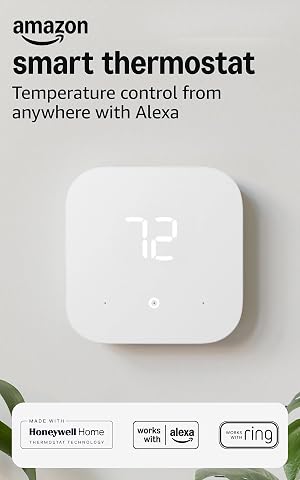
Amazon Smart Thermostat – Save Money and Energy, Works with Alexa and Ring (C-wire Required)
- ✔ Model: S6ED3R
- ✔ Dimensions: 3.56 × 3.56 × 0.84 inches
- ✔ Weight: 3.86 oz
Neither category guarantees lower energy bills; results depend on your equipment, climate, settings and habits. Choose a learning thermostat if your routine changes often and you want the system to adapt. Choose a programmable model if you prefer to set a schedule yourself, want to spend less, or need straightforward control. Compatibility with your heating and cooling equipment should come before either feature set.
At a Glance
| Criteria | Learning smart thermostats | Programmable smart thermostats | Winner |
|---|---|---|---|
| Upfront value | Often costs more; value depends on using its adaptive features. | Often costs less while retaining app control and scheduling. | B |
| Schedule automation | Learns patterns and may adjust schedules automatically. | Runs schedules and settings the owner creates. | A |
| Control and predictability | Can adapt in the background, though its changes may need review. | More predictable because changes generally follow user-defined rules. | B |
| Setup and daily effort | Less schedule maintenance after an initial learning period. | Requires occasional schedule edits when routines change. | A |
| Compatibility considerations | Must match the HVAC system; advanced functions can depend on wiring and equipment. | Must also match the HVAC system; simpler models may fit basic setups, but check specifications. | Depends |
| Energy use and savings | May help reduce unnecessary heating or cooling, but savings are not guaranteed. | Can support savings when schedules and temperature settings are managed well. | Depends |
| Household sensing | Some models support room sensors or occupancy features; availability varies. | Features vary; some models support additional sensors, while others rely on the thermostat location. | Depends |
Google Nest Thermostat – Smart Wi‑Fi Thermostat for Home
The Google Nest Thermostat takes the top spot because it combines remote app control and programmable schedules with a useful advantage at installation: it can operate without a C-wire in many homes. That flexibility makes it a better first shortlist option than the Amazon model, which explicitly requires a C-wire or adapter. Nest also offers energy-saving suggestions and HVAC monitoring alerts, giving owners more than a way to change the temperature when they are away.Its appeal is strongest for people who want a straightforward connected thermostat rather than a broad set of platform integrations. Control is available through the Google Home app and voice assistants, and the listed setup is designed for DIY installation in about 30 minutes. But “no C-wire” is not a universal promise: heating-only and zone-controlled systems, among others, may still need a wire or power accessory. We should check the compatibility details before treating installation as simple.Compared with the Sensi ST55, Nest is the more compelling pick when reducing wiring friction matters, while Sensi is more attractive when Apple HomeKit support, a larger display, or privacy emphasis is a priority. Nest’s battery-powered design may also mean periodic battery replacement, and reliable Wi-Fi is important for connected features. It is our best overall recommendation for compatible homes, but not the best fit for every HVAC configuration.
Pros:
- Works without a C-wire in many homes, simplifying installation.
- Remote control through Google Home and major voice assistants.
- Programmable schedules plus energy suggestions and HVAC monitoring alerts.
- ENERGY STAR certified.
Cons:
- Some HVAC setups still need a C-wire or power accessory.
- Battery-powered operation may require periodic battery replacement.
- Connected functions depend on reliable Wi-Fi and compatible devices.
Best for: Households seeking app and voice control with a chance of avoiding new C-wire installation.
Not ideal for: Owners of heating-only, zone-controlled, or otherwise unsupported systems who cannot add a C-wire or power accessory.
Bottom line: For compatible homes, Nest is the most balanced starting point because its wiring flexibility complements useful everyday app and schedule controls.
“For compatible homes, Nest is the most balanced starting point because its wiring flexibility complements useful everyday app and schedule controls.”
Sensi Smart Thermostat (ST55) – Wi‑Fi, DIY Installation, Alexa Compatible, Energy Star Certified
Sensi ST55 is the pick for households that want a thermostat to fit into more than one smart home ecosystem. Its listed compatibility includes Alexa, Google Assistant, Apple HomeKit, SmartThings, and Vera, giving it a wider platform spread than the Nest and Amazon models in this lineup. That breadth makes it easier to choose when family members use different devices or when the home already relies on Apple’s ecosystem.Installation support is another differentiator. A built-in level helps with a tidy wall mount, while step-by-step app guidance can make a DIY replacement feel less like guesswork. The thermostat also includes flexible scheduling, usage reports, remote monitoring, and a filter-change indicator. Sensi emphasizes data privacy, which may matter to buyers who want connected controls but pay attention to how personal information is handled.The tradeoff is wiring uncertainty: some systems require a C-wire, so the Sensi is not automatically a simpler installation than Nest. Its corded electric power and 24V AC specification also make compatibility checks essential. Compared with Amazon’s Alexa-focused model, Sensi is more adaptable across platforms; compared with Nest, it puts more emphasis on setup guidance and privacy than on avoiding a C-wire. Its energy-saving claims are not a guarantee of results, since savings depend on the home and usage.
Pros:
- Works with Alexa, Google Assistant, Apple HomeKit, SmartThings, and Vera.
- Built-in level and app guidance support DIY setup.
- Usage reports, flexible schedules, remote monitoring, and filter reminder.
- Emphasizes data privacy.
Cons:
- Some HVAC systems may require a C-wire.
- Compatibility still depends on the home’s HVAC wiring and system type.
- Projected energy savings depend on household use and conditions.
Best for: Households using a mix of Apple, Google, and Alexa devices that want guided DIY installation and scheduling tools.
Not ideal for: Buyers who cannot confirm C-wire availability or need a thermostat specifically suited to a system that requires a power workaround.
Bottom line: Sensi is the strongest choice when broad platform support and setup guidance matter more than minimizing wiring requirements.
“Sensi is the strongest choice when broad platform support and setup guidance matter more than minimizing wiring requirements.”
Amazon Smart Thermostat – Save Money and Energy, Works with Alexa and Ring (C-wire Required)
The Amazon Smart Thermostat makes the most sense when Alexa already anchors the home. It can connect thermostat control with the Alexa app, voice commands through an Alexa-enabled device, and routines that adjust comfort based on temperature and presence. Schedules, vacation mode, humidity sensing, and an air-filter ordering feature round out the controls. For an Alexa household, this creates a more integrated experience than the platform-neutral appeal of Sensi.That focus comes with clear requirements. This model needs a C-wire or a separate power adapter kit, making it less forgiving than Nest for homes with uncertain wiring. It supports 2.4 GHz Wi-Fi only, so a network that offers only 5 GHz connectivity will not fit the stated requirement. There is no built-in far-field microphone, either; voice control depends on a separate Alexa-enabled device. Check the HVAC system as well: it supports many 24V systems but not 110–240V HVAC systems.Compared with Nest, Amazon gives Alexa routines a central role but asks more of the wiring and network. Compared with Sensi, it is less flexible for households using Apple HomeKit or Google Assistant as their primary platform. Its ENERGY STAR certification and stated savings estimate may be appealing, but outcomes vary with equipment and use. This is a focused option for compatible Alexa homes, not a general-purpose pick for every connected household.
Pros:
- Alexa app and routine integration for connected temperature control.
- Includes scheduling, vacation mode, and humidity sensing.
- ENERGY STAR certified.
- Works with many conventional forced-air, heat-pump, and radiant-boiler systems at 24V.
Cons:
- Requires a C-wire or optional power adapter kit.
- Supports 2.4 GHz Wi-Fi only.
- A separate Alexa-enabled device is needed for voice commands.
Best for: Alexa users with a compatible 24V HVAC system, C-wire or adapter, and 2.4 GHz Wi-Fi.
Not ideal for: Homes without the required power setup, networks limited to 5 GHz, or buyers seeking built-in voice control or broad platform choice.
Bottom line: Choose Amazon when Alexa routines are central to your home and the required wiring and 2.4 GHz network are already available.
“Choose Amazon when Alexa routines are central to your home and the required wiring and 2.4 GHz network are already available.”
As an Amazon Associate we earn from qualifying purchases.
Key Differences
The main distinction is who maintains the schedule. A learning thermostat can notice recurring patterns and adjust its routine, which may suit a household with irregular arrivals or frequent changes. That convenience has a tradeoff: the thermostat’s decisions can be less transparent, and you may need to review settings if it learns a pattern you do not want. A programmable smart thermostat keeps the schedule more directly in your hands. It may take more upkeep when life changes, but its behavior is easier to anticipate.
Price and compatibility shape the decision as much as automation. Learning models often cost more, so their added convenience is worth paying for mainly when it will reduce schedule management or make useful occupancy features available. A lower-priced programmable model can be the better value for steady routines and owners willing to set a schedule. In either category, verify support for your furnace, heat pump, boiler or other equipment before buying. Features and wiring needs vary by model, and smart control alone does not guarantee lower bills.
Detailed Comparison
Upfront value (Programmable smart thermostats wins — moderate)
Programmable smart thermostats usually win on purchase price while still offering app access and scheduled temperature changes. Learning models charge more for adaptive scheduling and related conveniences. This is a moderate difference: the premium makes sense when you will use the automation, but it is hard to justify for a fixed routine.
Schedule automation (Learning smart thermostats wins — major)
Learning models win by building or adjusting routines from observed patterns, reducing the need to enter every schedule change yourself. Programmable models follow the schedule you set and generally need an edit when your routine changes. The gap is major for households with irregular days, but minor if the home follows the same weekly pattern.
Control and predictability (Programmable smart thermostats wins — moderate)
Programmable models have the edge for owners who want temperature changes to follow clear, user-entered rules. Learning models can adapt without a manual schedule change, which is convenient but may occasionally require a correction. This is a moderate tradeoff: choose predictable settings if you dislike reviewing automated behavior.
Setup and daily effort (moderate difference)
Learning models can require more initial setup as they gather patterns, but can reduce later schedule edits. Programmable models are often easier to understand at first, then ask for more attention when work hours, school runs or seasonal routines shift. The winner depends on timing: learning models favor less ongoing management, while programmable models favor direct setup.
Compatibility considerations (major difference)
Neither category wins across the board. Both must support your HVAC equipment and wiring, and some systems need a compatible adapter or particular thermostat features. Compatibility is a major purchase gate: check the manufacturer’s compatibility information for your exact equipment before comparing learning functions or app features.
Energy use and savings (moderate difference)
There is no automatic winner. Either thermostat can reduce unnecessary heating or cooling when it uses sensible schedules and temperatures; neither can promise a specific bill reduction. A learning model may help a busy household avoid heating an empty home, while a programmable model can do the same if its schedule is accurate. The practical difference is moderate and depends on use.
Household sensing (minor difference)
Learning models may offer occupancy detection or optional room sensors that can respond to activity beyond the thermostat’s immediate location. Programmable models vary: some also support sensors, while basic options do not. This is a minor to moderate difference by product, not a guaranteed category advantage. Check whether the sensors are included and what they actually control.
Learning smart thermostats: Pros and Cons
Pros:
- Can adapt schedules to recurring household patterns.
- May reduce routine schedule editing when plans change.
- Some models support occupancy features or additional room sensors.
Cons:
- Often costs more than a programmable model.
- Automated adjustments may need review or correction.
- Features, sensor support and HVAC compatibility differ by model.
Programmable smart thermostats: Pros and Cons
Pros:
- Often provides smart app control at a lower price.
- User-set schedules are straightforward and predictable.
- Can deliver useful automation when routines are stable.
Cons:
- Schedule changes usually require manual edits.
- May offer fewer adaptive or occupancy features, depending on model.
- Savings depend on the owner setting and maintaining effective schedules.
Who Should Choose What
Choose Learning smart thermostats if:
- Your household has shifting hours and you want the thermostat to adapt to recurring patterns.
- You value less schedule maintenance and are comfortable reviewing automated adjustments.
- You will use supported occupancy features or room sensors enough to justify the higher cost.
Choose Programmable smart thermostats if:
- Your household follows a consistent weekday and weekend routine.
- You want app control and schedules without paying extra for learning features.
- You prefer to decide exactly when temperatures change and can update the schedule when needed.
Skip both if: Your HVAC equipment is not supported, you need a control feature neither model offers, or you are seeking bill savings without changing temperature settings or schedules.
Value for Money
Pay more for a learning thermostat when its automatic schedule changes or supported sensing features solve a real household problem. For a family with variable arrivals, the time saved and improved control of an empty home may justify the premium, though savings are not guaranteed. If your schedule is stable, a programmable smart thermostat is usually the better value: you keep remote access and scheduling without paying for adaptation you may not need. Compare total installed cost as well as device price, especially if your system requires wiring changes or an adapter.
Final Verdict
For most households with predictable routines, choose a programmable smart thermostat. It gives you the core benefits—remote control and scheduled temperatures—at a lower typical cost, and its behavior is easy to understand. Choose a learning thermostat when your routine changes often and you want less manual schedule upkeep; pay the premium only if that convenience or its specific sensing features matter in daily use. The deciding factor is not the smart label but whether you want to maintain the schedule yourself. Before buying either type, confirm compatibility with your exact heating and cooling equipment.
Frequently Asked Questions
Will a learning thermostat always lower my energy bill more?
No. A learning model may adjust temperatures around household patterns, but the result depends on equipment, climate, settings and use. A well-maintained schedule on a programmable model can also limit heating and cooling when the home is empty.
Is a programmable smart thermostat difficult to manage?
Usually not if your routine is steady. You enter the schedule and can adjust it through the thermostat or its app. If your hours change frequently, expect to update the schedule or consider whether automatic learning is worth the added cost.
Can either type work with a heat pump or boiler?
Some models support heat pumps, boilers and other systems, but support varies. Check the manufacturer’s compatibility checker and wiring requirements for your specific equipment before purchasing.
Are room sensors included with smart thermostats?
Not always. Sensor support and what the sensors control vary by model, and accessories may cost extra. Check whether sensors are included and whether they affect temperature readings, occupancy routines or both.