
TL;DR

Get home appliances delivered free with Prime
- Fast, free delivery on millions of items
- Prime Video, Amazon Music and more included
- Member-only deals all year
Pro Tool Reviews tested six stud finders on a mock wall that included lath and plaster. The Franklin ProSensor M210/X2100 correctly located stud centers in all reported plaster tests and detected live AC, but produced false stud readings; the less expensive M70/X700 missed no studs and had no false detections, though it did not detect AC.
Pro Tool Reviews tested six stud finders on a mock wall that included lath and plaster, finding that the Franklin ProSensor M210/X2100 located the center of every tested stud. The result comes with a qualification: the device also gave false stud readings, so the report advises taking repeated measurements rather than relying on one scan.
In the report, Pro Tool Reviews says the M210/X2100 recorded 100% on-center detection and no missed or off-center readings in the plaster portion of its test. It also correctly detected live AC in all of the test instances reported. The review lists a 33% false-stud detection rate, meaning the device sometimes indicated another object as a stud. Its listed price was $59.99.
The review names the Franklin ProSensor M70/X700 as its editor’s choice. It detected all tested studs and recorded no false stud detections, but identified the center in 67% of detections and the edge as the center in 33%. It has no AC-detection feature, according to the report, and was listed at $21.99.
Two other models had mixed results. The Zircon HD70 recorded 67% on-center detection, 7% missed studs and 47% false detections; its AC detection rate was 50%. The JAXWQ 139-FYELLOW recorded 60% on-center detection, 7% missed studs and 33% false detections, with 50% AC detection. The supplied source excerpt does not include the results or recommendations for the other two models among the six tested.
Choosing a Finder for Plaster
The findings matter to homeowners and tradespeople because lath-and-plaster walls can be harder to scan than standard drywall. A false reading may lead someone to mark the wrong spot, while a missed stud can leave a fixture without the intended support. The report shows that performance varied even among popular models tested on the same wall setup.
The results also show a trade-off between center accuracy, false readings and AC detection. The M210/X2100 led on locating centers and detecting live wiring in this test, but its false readings make verification important. The less expensive M70/X700 avoided false and missed stud readings in the reported results, but cannot alert users to AC. A stud finder’s stud result should not be treated as proof that a location is safe to drill or cut.
stud finder for lath and plaster walls
As an affiliate, we earn on qualifying purchases.
As an affiliate, we earn on qualifying purchases.
How the Plaster Test Worked
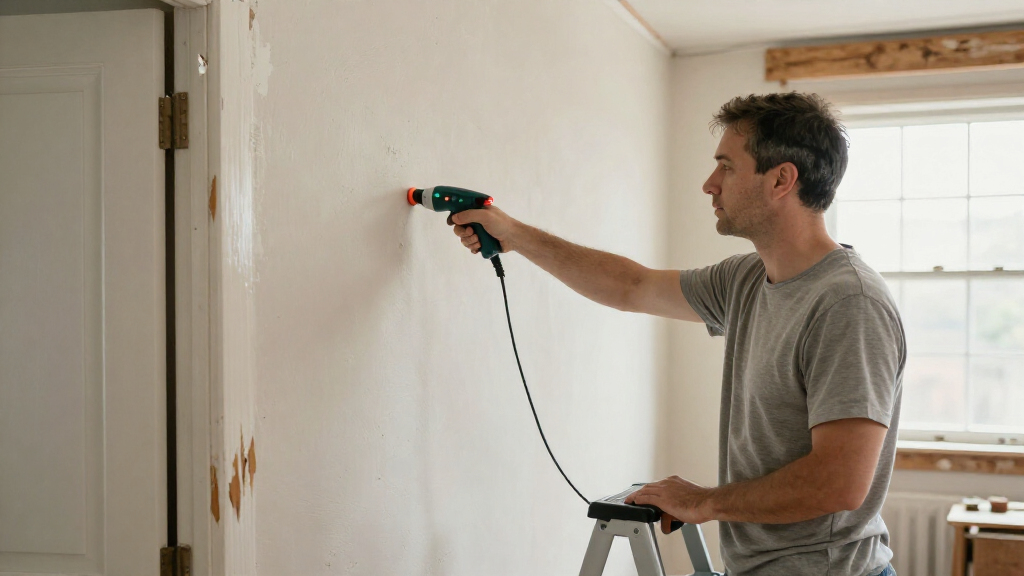
Pro Tool Reviews describes a mock-up built by Tom Gaige with separate sections of single-layer drywall, double-layer drywall and lath and plaster. Gaps between the sections let the testers see what was behind each surface. The test objects included standard and live-AC studs, a metal stud, live electrical conduit, PVC pipe and a water-filled copper pipe.
The reviewer says each finder was used with repeated scans from opposing directions, allowing it to reset or recalibrate where applicable. Results were grouped as on-center detection, off-center detection, missed studs, false stud detection and AC detection. These percentages describe the review’s test setup; they are not a guarantee of performance in every wall or building.
The report also cautions that older framing can vary and that stud spacing in lath-and-plaster walls may be inconsistent. Its testing guidance is to take multiple readings from both sides and compare the marks. That method is particularly relevant when a device gives conflicting indications or when the installation requires a precise center point.
“only one nailed the center of every stud”
— Pro Tool Reviews
Limits of the Reported Results
The supplied report excerpt does not state when the tests were conducted, how many individual scans contributed to each percentage, or how the results might change across different plaster thicknesses, lath materials and wall conditions. The figures apply to the review’s mock-up and testing method, not every lath-and-plaster wall.
The excerpt also ends before giving the names and performance figures for all six models. It does not provide enough information to assess those two devices or establish how representative the tested models are of the wider market. The listed prices are the amounts in the report and may not reflect current retail prices.
Verify Before Drilling
For a practical installation, the report recommends making repeated scans from opposite directions and comparing the marks before deciding where a stud center lies. Users should also account for the wall’s construction and avoid assuming that a nearby stud follows a standard spacing pattern, particularly in older buildings.
For work that involves cutting into a wall, the M70/X700’s lack of AC detection is a limitation, while the M210/X2100’s reported AC detection still should not be treated as a complete safety check. The source provides no follow-up testing schedule or additional findings. Its results are a comparison of the tested models under one stated setup, rather than a certification of safe drilling locations.
Key Questions
Which stud finder performed best on lath and plaster in the report?
The Franklin ProSensor M210/X2100 recorded 100% on-center detection in the review’s plaster tests. It also had a 33% false-stud detection rate, so the report recommends repeated measurements.
Was the less expensive Franklin M70/X700 reliable in the test?
It recorded no missed studs and no false stud detections, with 67% on-center and 33% off-center detection. The report lists it at $21.99, but says it does not detect AC.
Did the review test for live electrical wiring?
Yes. Its mock wall included live AC, and the review reported AC detection rates of 100% for the M210/X2100, 50% for the Zircon HD70 and 50% for the JAXWQ 139-FYELLOW. The M70/X700 has no AC-detection feature.
How should someone check a stud reading on plaster?
Pro Tool Reviews advises scanning from both sides and comparing repeated marks. Its report says multiple readings can help locate the center, but does not claim that any finder will work the same way on every wall.
Do these results apply to every plaster wall?
No. The percentages describe a specific mock-up and test method. The source does not establish performance across all plaster thicknesses, lath types or building conditions.
Source: rss
Halloween Picks
halloween
As an affiliate, we earn on qualifying purchases.